Verified board claims
Coaching you can trust: with verified board claims.
AI explains chess impressively well and still gets the board wrong on a regular basis. That is why Rookion checks what the coach claims about your board in the coaching dialogue against an engine.
The problem: language models hallucinate at the chessboard
Plain chat AIs demonstrably make things up at the chessboard: impossible moves, pieces on the wrong squares, variations that never existed. This is publicly documented many times over and takes minutes to reproduce yourself.
It is not about any single provider: it is the technology class. A language model knows language about chess, but not the truth of your board. It phrases things convincingly even when it is wrong. For small talk that is annoying. For coaching you are meant to trust, it is disqualifying.
Our principle: the engine knows the truth, the coach explains it
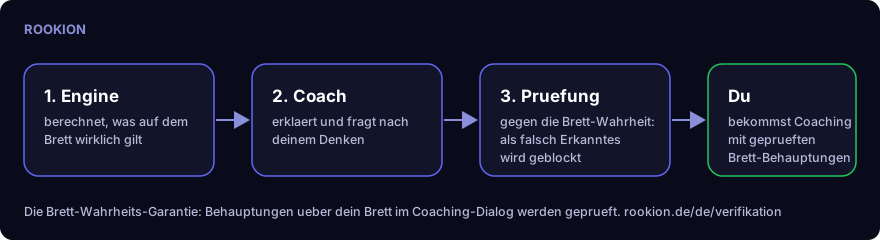
1. The engine calculates
A chess engine analyzes your game and computes what actually holds on the board: positions, threats, critical moments.
2. The coach explains
The AI coach talks with you about your decisions: understandable, in dialogue, based on your thought process.
3. The check decides
Claims about your board in the coach's answers about the analyzed game are checked against the engine board truth. If a draft fails the check, it is not displayed: you get a corrected answer or a deliberately more cautious one.
The Board-Truth Guarantee
Claims about your board in the coaching dialogue about the analyzed game are checked against the engine before you see them. If a draft fails the check, it is not displayed.
What this does not mean
The check applies to board claims in the coaching dialogue: the core of the coaching. It does not promise that every explanation is didactically perfect, that the coach always recommends the single best plan, or that every text in Rookion travels the same verification path. It promises: what the coach says about your position in the dialogue was checked against the engine.
The check is working. Every day.
Drafts where the check flagged at least one critical problem and that were therefore not shown in this form.
As of: 9/20/2026
Frequently asked questions
Why do AIs hallucinate at chess, of all things?
Because chess has exact truth and language models have none. A language model assembles words plausibly: at chess, plausible is not enough. A move is legal or it is not, a piece is on e5 or it is not. Without a connection to an engine, a language model has no access to that truth.
What happens when the coach is wrong?
If the check detects a false board claim in a draft answer, the draft is not displayed. Instead you get a corrected answer, or a deliberately more cautious one that only says what is certain.
What exactly gets verified?
The coaching dialogue about your game: where the coach makes concrete claims about your board, the engine check runs before the answer is displayed. That is not a sample: it is a fixed part of the delivery path in the dialogue. Accompanying texts, such as the final game summary, follow the same standard with their own safeguards and the principle from the next question: when in doubt, cautious over claimed.
Why does the coach sometimes say less rather than more?
If a statement cannot be safely confirmed, Rookion prefers saying less over claiming something false. A cautious answer is a sign the check is doing its job: not that the coach knows nothing.
Is this the same as an engine analysis?
No. An engine analysis shows you moves and numbers. Rookion uses the engine as the foundation of truth and coaches you on top of it: in dialogue, about your thinking, with explanations instead of variation lists.
For press
Rookion is an AI chess coach that checks claims about the board in the coaching dialogue against a chess engine: claims detected as false are caught instead of delivered. Questions, interviews, material: we reply quickly.